
Find New Haven Residents by Record Type
Think of a New Haven residents directory as a bundle of public-record trails. It is not one list. An assessor entry ties a titled owner to a parcel. A voter record can show registration, district, party, status, and birth year. It can also show participation history within Connecticut's rules. A deed index names the parties to a land instrument. It does not name everyone who uses a building. A library directory can place a household at an address in a given year. Each record describes a different role. Each also carries its own date. That is why leads must be read carefully.
Start with the narrowest question. A street clue means you should anchor the situs parcel before searching names. A person clue means keeping the full name, initials, age or year, and town together. Family history points to the New Haven Free Public Library. Newspapers, probate, and vital-record eligibility rules follow from there. A missing result may mean the record is protected. It does not mean the person never lived in New Haven.
- Search the Vision New Haven property database by the name or address already known, then save the parcel, situs, owner, mailing address, and assessment context.
- Use the Connecticut voter lookup for the official registration and polling-place route, while remembering that it is not a complete household roster.
- Move from the parcel owner to the New Haven City Clerk’s SearchIQS land-record index; grantor and grantee roles, legal descriptions, and book/page references matter more than a name alone.
- For an older address, use the library’s city directories, reverse sections, newspapers, and maps. Pair a directory line with an independent record before treating it as a household fact.
- When a record is not indexed or the online result is incomplete, make a focused Connecticut FOIA request to the office that holds it, naming the department, date range, address, and preferred delivery method.
Where New Haven Resident Records Are Kept
New Haven County has no active county clerk, county recorder, or county elections counter. Counties here have been geographic names since 1960. No county office keeps the records. For land and local vital work, the correct stop is the New Haven City Clerk. The assessor, tax collector, and registrars are city offices. Courts, probate, and vital records run through separate state or judicial channels.
New Haven City Clerk
200 Orange Street, Room 202
New Haven, CT 06510
203-946-8339
New Haven Assessor
165 Church Street
New Haven, CT 06510
203-946-4800
Vision property database
New Haven Registrar of Voters
200 Orange Street, Room 201
New Haven, CT 06510
203-946-8035
The City Clerk lists general hours of 9:00 a.m. to 5:00 p.m., Monday through Friday. Recording of land records ends at 4:00 p.m. SearchIQS hosts a guest index for covered records. The counter still matters for certified copies, older books, maps, and image questions. The assessor is a reference, not a deed or survey. The voter office can explain local list access, protected records, and the difference between a polling lookup and a file request.
Pair New Haven Vision and Parcel Records
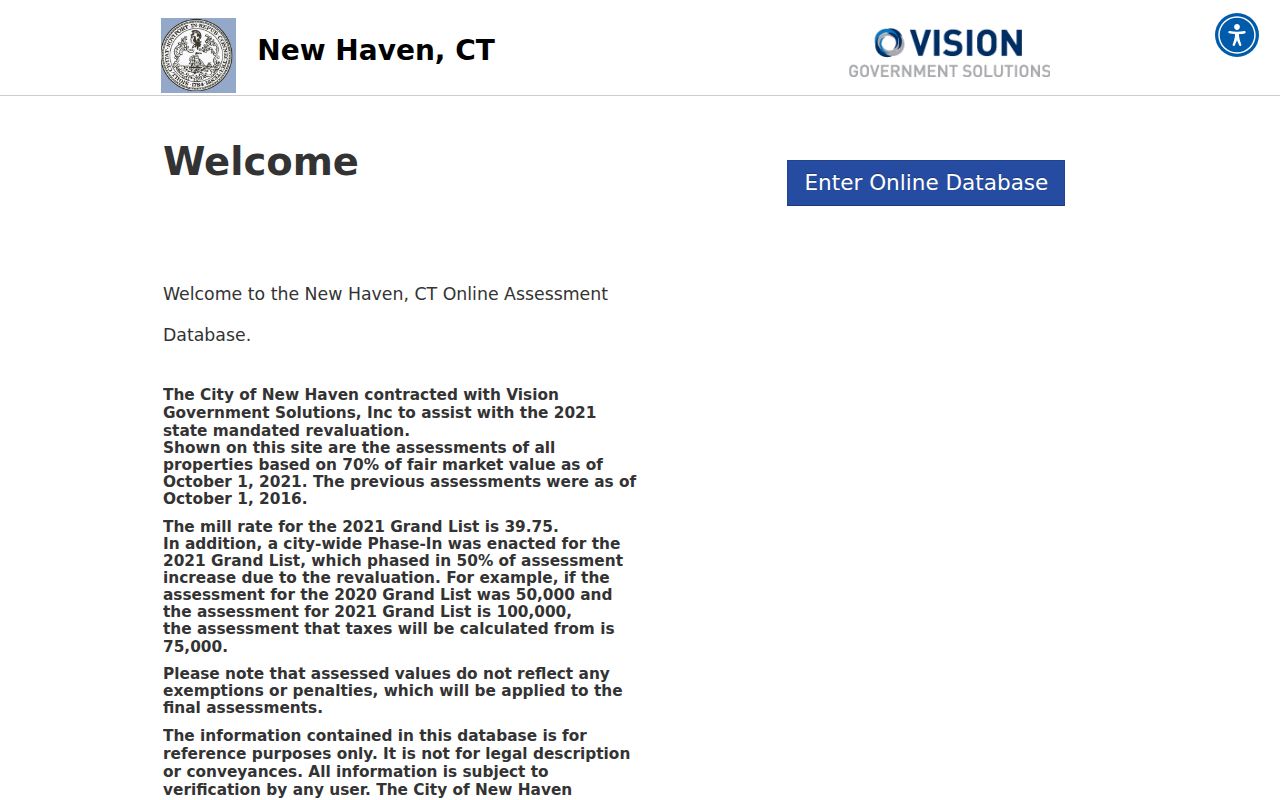
Vision New Haven greets you with a welcome screen. An "Enter Online Database" control leads into the online database. The landing page confirms owner-name, address, and parcel research. The inner ASP.NET form loads dynamically. Exact labels, partial-match rules, result counts, sorting, ZIP filters, and export controls are live-screen questions, not promises.
The Grand List follows an October 1 assessment date. The 2021 revaluation notice sets values at October 1, 2021 fair market value. Online values may omit exemptions or penalties. The GIS viewer adds the mapped polygon and adjacent lots. The strongest first record combines owner, situs, legal location, assessment year, and parcel geometry.
The Vision welcome screen shows the public entry point and its revaluation context.
Inside the parcel card, record only fields the live record actually labels. A mailing address can point elsewhere. The situs address is where the parcel sits. Neither field is a list of everyone connected with the property.
| Portal item | What the research confirms |
|---|---|
| Owner or name mode | Owner-name research is supported; exact field label and partial-match behavior were not captured. |
| Property or situs address | Address lookup is supported; house-number and street-field layout remains a live-screen gap. |
| Parcel or account key | A parcel/account mode is expected, but the New Haven format was not located in official sources. |
| ZIP filter and result controls | ZIP-capable searching, paging, sorting, print, and export were not exposed before database entry. |
New Haven's Current Resident Directory Sources
Current directory-like sources do not all list residents. That distinction is what protects the meaning of a search result. An owner record is not proof of occupancy. A voter line covers registered electors only. A staff contact card is a work contact, and a community meeting page is not a membership roster, so use the source that answers the question and add a second record with a matching date and place.
| Source | What it may identify | Keeper | Access and limit |
|---|---|---|---|
| Grand List / parcel card | Titled owner, situs, mailing address, value fields | New Haven Assessor | Vision and GIS reference; not a household census |
| Voter registry | Registered elector, district, party/status, participation | New Haven Registrar / SOTS | Public fields subject to Title 9 and privacy programs |
| Deed and map index | Grantor, grantee, instrument, legal description | City Clerk / SearchIQS | Guest index; images and certified copies have separate routes |
| Tax search | Property location, bill number, account and tax status | Tax Collector | Name, location, or bill search; payment fees are separate |
| Staff directory | City employee, title, department, phone | City of New Haven | Contact index, not residence evidence |
| Community umbrella | Neighborhood meeting, chair, specialist, map | Community Management Team | Public civic route; no complete private roster located |
For one person, the New Haven resident lookup keeps those roles separate. A street or block calls for the address pages instead. A name list should never become an assumption about everyone at a parcel.
The state's free eLicense lookup adds professional credential context. Its fields include license type, status, name, and number. Address filters appear when released. A credential or business address shows a public professional connection. It is not a home address. The eLicense search page shows that official-context surface.
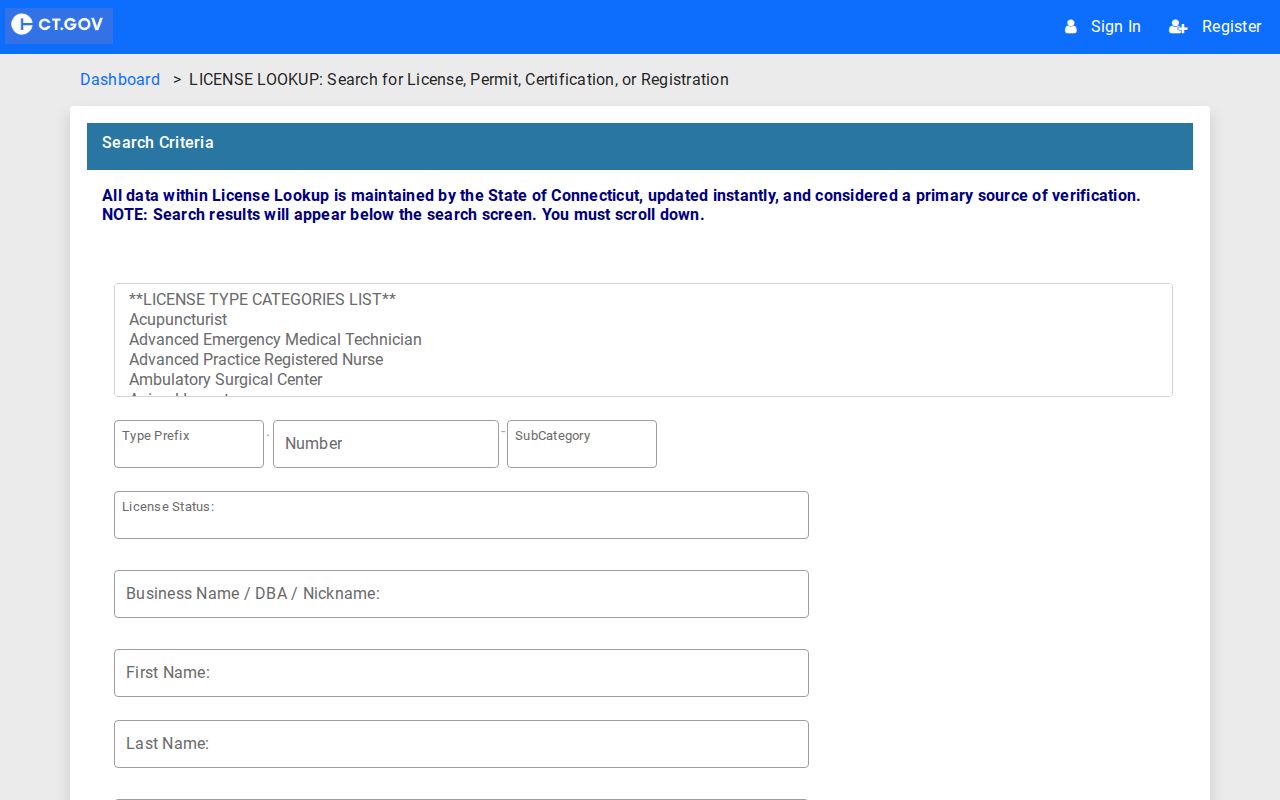
Cite a license with its result date and the issuing board's detail view. Keep occupational context tied to the record's stated purpose.
What New Haven's Voter Lookup Can Show
New Haven registrars keep the local voter list inside Connecticut's centralized system. A public lookup entry can be fairly detailed. Ordinary fields include name, residence street and ZIP, district or precinct, and party affiliation. Active or inactive status also shows. Birth year and election participation appear too. Birth month and day are exempt under PA 26-1 §96. Driver-license and Social Security numbers never appear. No ballot choice shows either.
The state lookup needs a live query, and its result layout varies with each search. For direct help, call the New Haven Registrar at 203-946-8035. Full voter-file requests go to the Secretary of the State. The file costs $300 and arrives as CSV. Requesters must certify a permitted election-related, scholarly, journalistic, political, or governmental purpose. The form bars harassment, advertising, solicitation, sale, marketing, reproduction, and unapproved personal or private uses. The public voter lookup screenshot works as an endpoint reference. It is not proof that every current field will display.
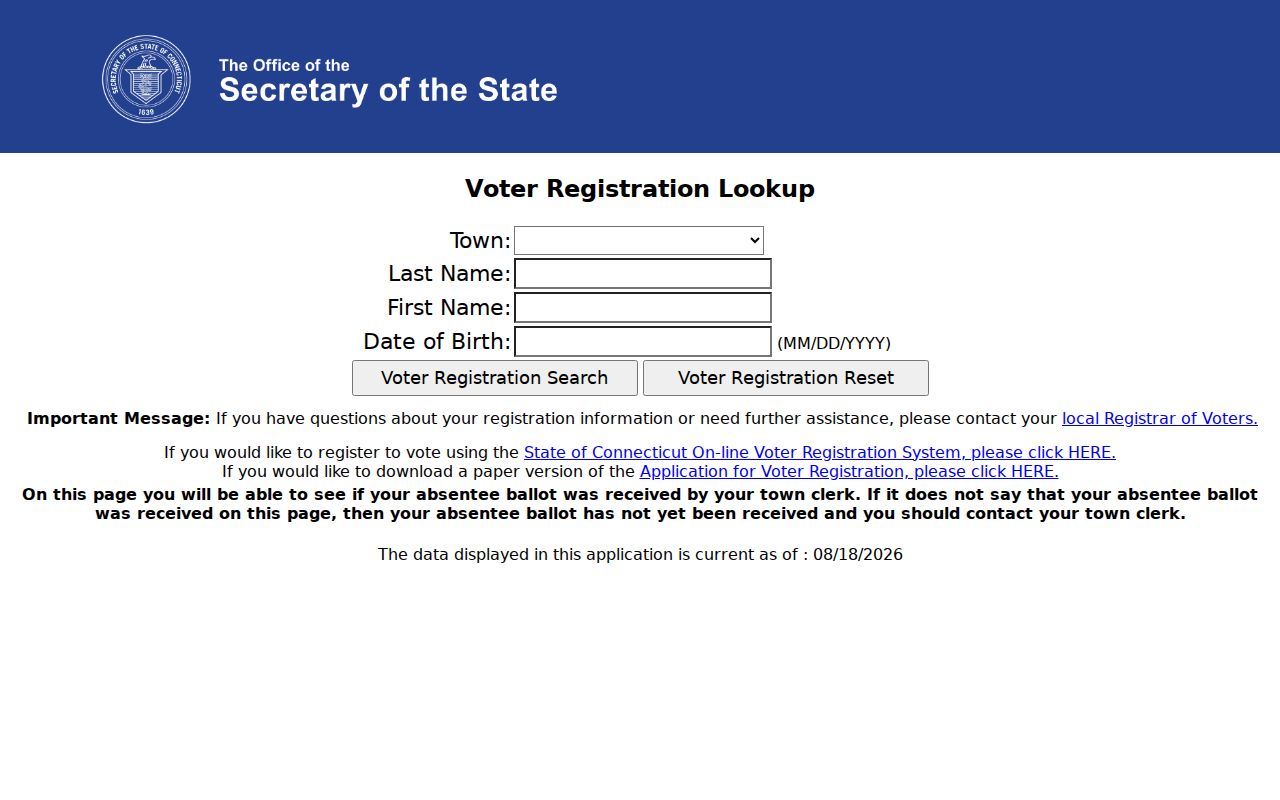
New Haven voter records can confirm a registration as of a recorded date. They do not list every person at an address. ACP or §9-50(d) protections can also suppress a name or street number.
Court and Probate Records, New Haven
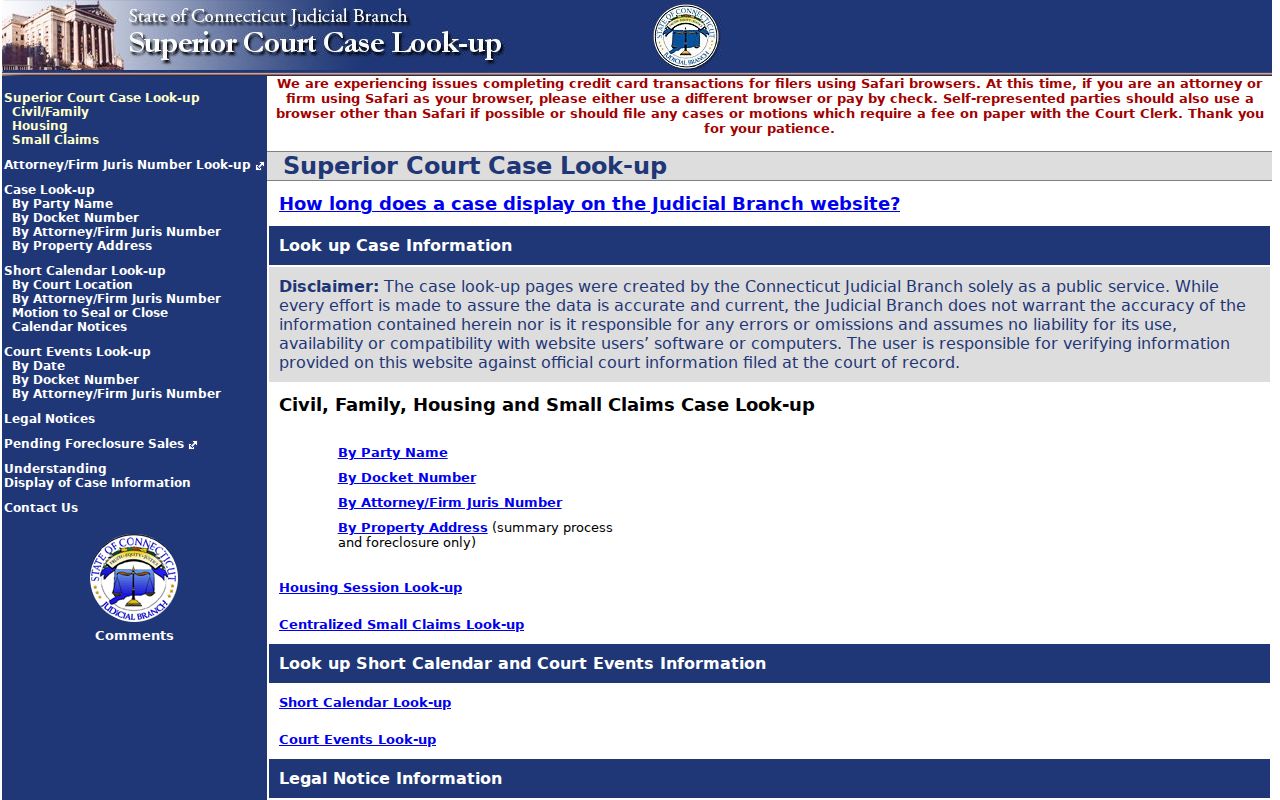
Connecticut's court systems answer case questions, not the question of who lives in New Haven. The courthouse for the Superior Court New Haven Judicial District sits at 235 Church Street. Its civil and family party search is flexible. Searches run by party name, docket, or property address. Inputs include last name, optional first name or initial, court location, docket number, or a separate address mode. A public result may show case number, parties, attorneys, motions, docket events, scheduled dates, and status, but it is an index rather than the official file.
Probate runs on a separate system. The Connecticut Probate Case Lookup covers decedent's estates and trusts through case type, district, status, first name, and last name. New Haven Probate District PD-38 is the local route. Result columns include case number, last name, first name, middle initial, type, and district. Online data is useful from January 5, 2011 forward, and earlier material is incomplete. Ask the clerk which permitted papers can be viewed.
Federal cases go through PACER. That route runs through the District of Connecticut courthouse. Criminal and motor-vehicle cases use a defendant search with last-name prefix, first initial, birth year, year range, court location, and category. Sealed, juvenile, protected, and aged-out matters may not appear, so confirm any identity through role, date, and geography. The civil inquiry screenshot shows the public index surface.
New Haven County posts no local jail roster. Custody lookups run at the state level instead. The Connecticut DOC inmate search updates daily and works by DOC number, name, or date of birth. Results shift as custody changes. The state custody endpoint serves readers who need that narrow record type, not a general resident roll.
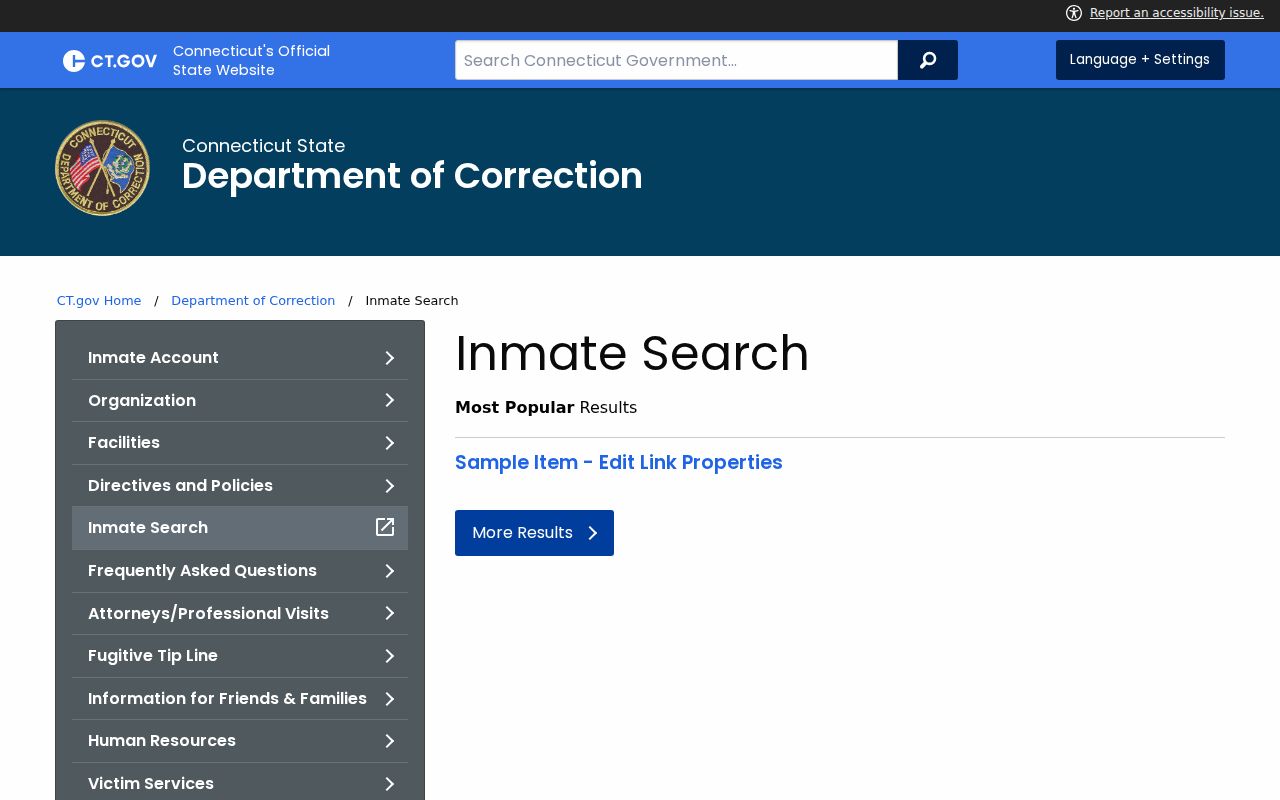
Confirm any status with the custodian, since a name match alone is never enough.
New Haven Vital Records Have Different Windows
New Haven's local registrar issues certified copies for events held in the city, and the Connecticut Department of Public Health supplies statewide routes. Current vital records are not an open name directory. Birth certificates stay confidential for 100 years. The statute is CGS §7-51. Eligibility rules cover the person, close relatives, authorized representatives, genealogists, and other listed requesters. Births from 2003 forward get broader town choice. Earlier births follow tighter rules.
Death and marriage or civil-union certificates are generally open to a requester age 18 or older under CGS §7-51a. Social Security numbers and other protected fields stay restricted. Fees are $20 for town and state death and marriage copies. State birth copies run $30. DPH accepts mail, in-person, and approved VitalChek routes, though processing can take up to 12 weeks. Divorce decrees stay with the granting Superior Court.
The DPH vital-record forms hub is the starting point for applications, IDs, relationship proof, payment, and submission steps. If no permitted copy route fits, turn to the library's historical indexes, newspaper runs, or a focused request to the custodian rather than assuming a current public index exists.
Earlier New Haven Residents in Directory Books
City directories for New Haven survive in nearly unbroken runs. The New Haven Free Public Library keeps them from 1840 through roughly 1990. Microform covers 1840 through 1960. Later volumes, mostly from Price & Lee, fill the shelf. Reverse and address sections go back to about the 1920s. The layout differs by volume, though. Visit Ives Main Library at 133 Elm Street. Ask the Local History Librarian how each year and format is arranged.
An entry can list a name. It may also show an occupation, a spouse notation, an address, a business, or a telephone detail. Treat it as a dated snapshot. It is not a census and not proof of title. Once an address entry turns up, search the alphabetical section for the matching name line. Then corroborate with a deed, map, obituary, newspaper item, probate case, or census schedule. The New Haven city directory collections page carries the full shelf. It also offers a method for reading it.
Two more library tools extend the reach. The Library of Congress offers a digitized Connecticut telephone-directory reel spanning localities and years from 1878 through 1899. It is not a single New Haven roster, so inspect the locality heading and image carefully. NHFPL’s newspaper microfilm includes the New Haven Register from 1871 through 2019. It also holds other local runs and a paid obituary search service. A notice can pin a move, a death, a business, or a relative to a date. It still needs a second source.
New Haven ZIP Codes and City Lines
A ZIP code routes mail. It does not draw a New Haven parcel line. USPS zones, Census ZCTAs, and wards can disagree about the same spot. So can neighborhood labels. GIS polygons can too. Deed legal descriptions can as well. ZCTAs 06510, 06511, 06512, 06513, 06514, 06515, 06517, and 06519 each intersect New Haven differently. Some ZIP references reach into adjacent towns, Yale or institutional routes, or post-office groupings.
The USPS ZIP Code Lookup validates a full street address with city and state. Its three modes cover address, city and state, and cities by ZIP. USPS itself cautions that a returned ZIP confirms no person or business. It sets no legal boundary. For property work, match the situs address against the assessor and GIS. A mailing ZIP can even belong to the owner’s correspondence address rather than the parcel.
ZIP granularity earns its keep once an address is anchored. It can narrow a property or tax search. It cannot prove residency, neighborhood membership, or a voter-file entry.
New Haven Record Requests and FOIA
The Connecticut Freedom of Information Act, CGS §§1-200 through 1-243, is the fallback whenever city records lack an online index. Any person may ask, orally or in writing. New Haven encourages its online form. A tight request names the record, the department, the date range, an address or parcel, and a preferred delivery method. The city may seek clarification, review exemptions, charge copying costs, or require prepayment above $10.
The Connecticut FOIA compilation explains access, copies, fees, arrest-record access, and residential-address nondisclosure. New Haven’s form accepts e-mail, mail, fax, online, or telephone delivery plus electronic, printed, or in-person inspection. Under FOI Commission guidance, silence for four business days can be treated as a denial. That is no promise of production in four days. The city’s FOIA request form displays the fields a requester will fill in.
Use the New Haven FOIA request form when it fits the record. FOIA never overrides sealed, confidential, safety, personal-data, or other statutory exemptions.
- Identify the custodian, such as the City Clerk, Assessor, Building Department, Registrar, police Records Division, or a state office.
- Describe one record type and a bounded date range. Include a parcel, street, case number, or name only when it helps locate the file.
- Choose inspection or a copy format, ask for an estimate when fees may exceed $10, and keep the request and acknowledgment.
- If access is denied or delayed, preserve the dates and appeal to the Connecticut Freedom of Information Commission within the stated period.
New Haven Record Layers
A good New Haven residents directory search is a chain of small answers. The assessor says who is listed with a parcel. GIS shows where the polygon and neighboring lots sit. The deed index reveals who granted or received an interest, a directory shows who was listed at an address in a given year, and the voter roll names which registered electors and participation fields are releasable. Courts, probate, vital records, and licenses then add role-specific evidence.
- Roll
- A list maintained for a defined purpose, such as assessment, taxation, or voter registration. It is not a list of everyone in a household.
- Index
- A finding aid that points to a record. SearchIQS can point to a deed image, while the index itself is not the full instrument.
- Parcel
- A mapped piece of land with a legal location. Its situs address and an owner’s mailing address can be different.
- Criss-cross directory
- A reverse or address section arranged by street and number, useful for finding a listed name before checking the alphabetical section.
Official records and paid compilation services answer different questions. A paid site may blend public indexes with purchased data into stale or wrongly merged reports. A fee does not make a result official. Judge a source by its custodian, date, role, and correction route.
| Source type | Strength | Limit to keep visible |
|---|---|---|
| Custodian record or official index | Clear office, record role, date, and correction path | May be incomplete, protected, dated, or limited to one purpose |
| Library or archive collection | Historical context, scans, finding aids, and local interpretation | Usually requires in-person work, an appointment, or assisted search |
| Commercial compilation | May gather several public leads in one report | May be stale, mismatched, incomplete, or subject to a separate opt-out process |
New Haven's Current Records Keep Changing
Recent local initiatives open new routes but never replace the custodians. In September 2025, the City Clerk publicized a property-fraud alert tied to SearchIQS. The alert watches a location and up to ten name combinations. It then e-mails the subscriber when a document records. It is a notification service, not a title guarantee. In March 2026, NHFPL and Yale introduced Memory Map for preserving local photographs and documents. Its rights and submission terms deserve a check before any reuse.
A May 2026 Freedom of Information Commission decision involving CitySquared described a public parcel permit and application database. It shows why portal completeness should be tested against the city office or a FOIA route. Vision 2034 is another current planning milestone. Read planning material as neighborhood context, not as a resident index.
Connecticut’s Big List unclaimed-property search is a separate, free name lead. It covers assets held by the Treasurer, not a person’s New Haven address. The state’s Big List search screen shows the lookup fields.
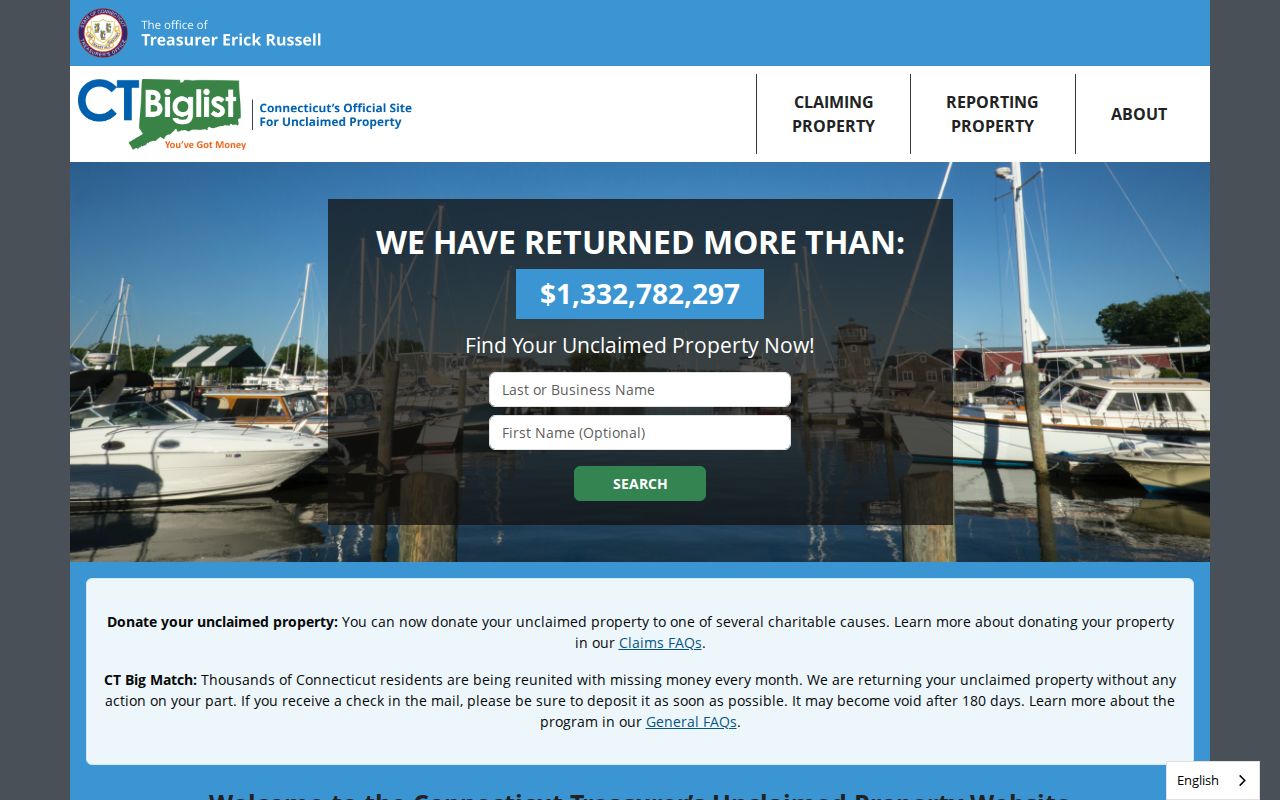
Any claim drawn from a Treasurer record still needs to be verified with that office. A residents directory lead is only a starting point.
Use New Haven Records With Care
Connecticut builds deliberate gaps into its records. The Address Confidentiality Program gives approved participants a substitute mailing address. The real one stays shielded. A separate voter privacy statement under CGS §9-50(d) can keep a name or street number off the ordinary registry list. FOIA exemptions, sealed court matters, protected vital fields, and redacted land images also limit what can be copied.
Use only the minimum information your purpose requires. That means family history, reconnection, an heir question, civic research, or a property record you have a lawful reason to check. Save the public record date and the source URL. Never copy Social Security numbers or try to rebuild a protected address from another record. Errors have their own channels. A wrong parcel goes to the Assessor. A wrong image or index goes to the City Clerk. The Registrar, courts, DPH, SOTS, and probate offices each route corrections their own way.
Personal, lawful use matters. New Haven public records are not an invitation to threaten, follow, repeatedly contact, or intimidate anyone. Connecticut stalking and harassment laws, voter-file certifications, DPPA limits on motor-vehicle data, and custodian privacy rules all apply. Stop when a record is protected or a person asks for no contact.
A good residents directory search ends well. You have the right custodian, a dated record, and a clear sense of what that record does not prove. That standard keeps a useful New Haven lead from turning into a false identity claim.